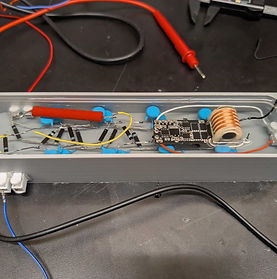
Stabilizing Plasma Propulsion
State Space Identification and Closed Loop Control of EHD and DBD Actuators
Plasma based ElectroHydroDynamic and Dielectric Barrier Discharge actuators offer a path to silent, compact, zero moving part propulsion and flow control. Although the underlying physics can generate sufficient ion driven force, these actuators exhibit extreme variability in real environments, with thrust swings exceeding 300 percent under changes in humidity, pressure, and surface condition. No validated dynamical model yet describes the mapping from discharge regime to force output, and no closed loop controller exists to stabilize performance. This project develops a physics guided and machine learning enhanced framework that treats plasma actuation as a nonlinear but observable system. By measuring plasma state directly, the effort aims to convert an intrinsically unstable actuator into a controllable and reliable propulsion technology.
01
Overview

The project focuses on stabilizing ElectroAeroDynamic and Dielectric Barrier Discharge plasma actuators by integrating multi modal sensing, physics guided state space modeling, and embedded real time control. These actuators hold considerable promise for aerospace and robotics because they operate silently, contain no moving parts, and can be engineered at millimeter scales where mechanical systems fail. Their ability to directly couple electrical energy into airflow makes them attractive for micro UAV propulsion, aerodynamic control surfaces, and compact robotic actuators. Yet despite these advantages, current devices remain fundamentally limited by large variability in their discharge behavior. Humidity, pressure, dielectric surface condition, electrode aging, and contamination all introduce rapid, unpredictable shifts in discharge regime that produce large swings in thrust output and render open loop operation unreliable.
A key observation motivating this work is that while thrust varies dramatically, the internal plasma state does not evolve arbitrarily. Electrical waveforms, optical emission patterns, mechanical force signatures, and environmental indicators contain structured information about the underlying discharge dynamics. These measurable signatures suggest that EAD and DBD thrusters can be represented as nonlinear but observable dynamical systems. Building on this insight, the project seeks to develop an integrated modeling and sensing architecture capable of identifying these internal modes and predicting regime transitions before they manifest as thrust instability. By embedding this model within a microcontroller based control framework, the approach supports real time waveform shaping, frequency and duty cycle tuning, and bias optimization to correct for drifting discharge conditions.
Through this combined sensing and control architecture, the project aims to transform plasma actuators from inherently chaotic devices into stable, commandable propulsion and flow control systems. Establishing this foundation is essential for advancing plasma based actuation into flight ready technologies suitable for precision maneuvering, safety critical applications, and next generation robotic platforms.
02
Challenges and Problem
EHD and DBD actuators suffer from severe thrust instability because their force output depends sensitively on plasma discharge regimes that shift with humidity, pressure, temperature, dielectric surface condition, and electrode aging. In laboratory environments, these actuators can produce measurable and repeatable thrust, but in real conditions their output can vary by factors of two to three, making them unsuitable for any application that requires consistent performance. The underlying difficulty is that the plasma to force mapping is governed by nonlinear, multi regime physics that are not captured by existing analytical or empirical models. No validated framework currently explains how electrical excitation, charge distribution, ion drift, and local flow structures combine to generate net aerodynamic force in these devices.
This lack of modeling accuracy is compounded by a second major challenge: the complete absence of closed loop control architectures for EHD and DBD propulsion. Because the relationship between input waveform and output thrust is neither stationary nor monotonic, traditional control methods fail to stabilize thrust or maintain operating points. Small perturbations can cause abrupt regime changes in the discharge, resulting in sudden drops or surges in force. Environmental sensor noise, dielectric degradation, and surface contamination further obscure the internal state of the plasma, leaving controllers without reliable feedback signals. As a result, EHD and DBD actuators cannot meet the safety, repeatability, and precision requirements necessary for aerospace maneuvering, micro UAV propulsion, or robotic actuation in real operational environments.

03
Research Approach

The research approach builds on the premise that EHD and DBD actuators, despite their unstable thrust output, exhibit measurable and structured plasma state signatures that can be used to reconstruct their underlying dynamics. The project develops a sensing architecture that collects electrical, mechanical, optical, and environmental measurements in parallel. Current and voltage waveforms capture charge transport and discharge mode transitions. Optical emission and micro spectrometry provide information about ionization regimes and energy distribution. Mechanical thrust sensors supply ground truth force behavior, and environmental sensors document the external conditions that drive drift. Together, these channels provide a multi perspective view of the plasma that is essential for treating the actuator as an observable system.
Using this sensing framework, the project constructs a physics guided state space model that describes the evolution of the plasma discharge as a nonlinear dynamical system with identifiable operating regimes. This model incorporates structural features of EHD and DBD physics, such as space charge accumulation, streamer development, dielectric surface interactions, and frequency dependent discharge behavior. Machine learning methods are used only where classical models cannot capture residual variability, ensuring that the resulting representation remains interpretable and grounded in plasma physics. This state space formulation enables inference of internal plasma states, prediction of regime transitions, and quantification of sensitivity to environmental changes.
The final component of the research approach integrates this model with an embedded real time control architecture. A microcontroller based system executes waveform shaping, frequency adjustment, duty cycle modulation, and bias tuning to regulate the discharge and maintain stable thrust output. Closed loop control laws are informed by the learned and physics based structure of the state space model, allowing the system to compensate for drift, reject disturbances, and avoid transitions into unstable discharge regimes. By combining sensing, modeling, and control in a unified architecture, the approach converts inherently chaotic EHD and DBD actuators into stable, commandable propulsion and flow control devices suitable for precision critical applications.
04
Long Term Impact
The long term significance of this work lies in establishing plasma based EHD and DBD actuation as a reliable and controllable technology class for aerospace, robotics, and advanced propulsion. A validated state space representation and closed loop control architecture provide the scientific and engineering foundation needed to transition these actuators from laboratory demonstrations to flight critical systems. Stable plasma driven thrust would enable silent micro UAVs, compact aerodynamic control surfaces, and zero moving part robotic actuators that operate in environments where mechanical solutions are impractical, fragile, or unsafe. More broadly, the project creates a framework that links plasma physics, system identification, and control theory, opening the door to a new generation of intelligent plasma actuators capable of adapting to environmental variability and maintaining consistent performance. By resolving the reliability barrier that has prevented adoption for decades, this work positions plasma propulsion and flow control to impact a spectrum of applications ranging from lightweight aerial platforms to next generation autonomous systems.

Publications
In progress
Reference
Add a Title
Reference
Ackhnowledgements
-
Text
Gallery